
Tax Planning Before the Budget: Should You Act or Wait?
Is tax uncertainty keeping you awake at night?
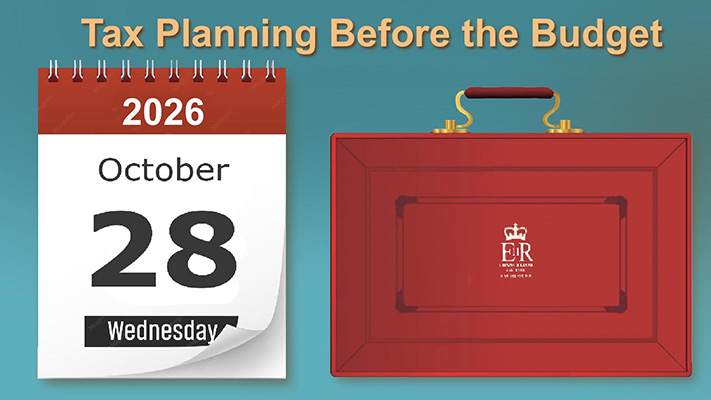
With the Budget taking place on 28 October 2026, speculation about possible tax changes is gathering pace. Pensions, inheritance, property, investments and business taxation can all become subjects of pre-Budget predictions.
For individuals and business owners, this creates a difficult question: should you act now in case the rules change, or wait until you know what the Chancellor has actually announced?
Good tax planning before the Budget is not about correctly guessing what will happen. It is about understanding where you stand today, what decisions you are considering and what the consequences could be if your assumptions turn out to be wrong.
There is a recent example of why that distinction matters.
The problem with pre-Budget uncertainty
A confirmed tax change gives you something concrete to work with. You know what is changing, when it takes effect and, eventually, the detailed rules surrounding it. You can then consider whether action is appropriate.
Pre-Budget speculation is very different; a newspaper report or prediction may concern a genuine policy the government is considering. Equally, it may never make it into the Budget.
This can produce two very different reactions. Some taxpayers put decisions on hold because they are worried about what may happen next. Others feel they need to act immediately in case a valuable allowance or tax treatment disappears.
Before doing either, there is one useful question to ask:
Would I still make this decision if the expected Budget change did not happen?
The experience of some pension savers in 2024 shows why that question matters.
What pension tax-free cash can teach us about Budget speculation
In the run-up to the October 2024 Budget, there was considerable speculation about possible changes to pension tax-free cash.
Under current rules, most people can normally take up to 25% of their pension as tax-free cash, subject to a standard lump sum allowance of £268,275, although some people have protected higher allowances.
Amid concern that this favourable treatment might be restricted, some pension holders accessed their tax-free cash before the Budget. Ultimately, the 2024 Budget did not introduce the widely speculated restriction on tax-free cash from pensions.
For some who acted early, the obvious response was to ask whether they could simply put the money back, but it wasn’t that straightforward.
HMRC subsequently confirmed that pension schemes had received requests from members wanting to return lump sums they had taken because of speculation about the Autumn Budget. It also made clear that a tax-free lump sum payment could not simply be undone for tax purposes and that returning the money would not restore the lump sum allowance that had been used.
That doesn’t mean everybody who took pension cash before the Budget made the wrong decision. Someone may already have had a perfectly sound reason for accessing their pension.
The problem arises when a significant financial decision is made mainly because of a tax change that hasn’t actually happened.
Tax is only one part of the decision
The same principle applies well beyond pensions.
Imagine you are considering selling an investment or property and there is speculation about changes to Capital Gains Tax. Bringing forward the sale might look attractive if you believe tax rates are about to rise.
But what if they don’t?
Perhaps you weren’t otherwise ready to sell. Maybe the asset was providing useful income or formed part of a longer-term plan.
Inheritance Tax creates similar questions.
Concern about future changes could encourage someone to make substantial gifts earlier than intended. Yet once assets have been given away, the donor may lose access to money or property they later need.
Business owners can face equally important decisions around investment, company structure, succession and taking money from their businesses.
There may be legitimate tax reasons to act before a Budget. However, you should weigh the tax saving against the wider financial, commercial and personal consequences.
Saving tax on a transaction doesn’t automatically make the transaction a good decision.
What tax planning should you do before the Budget?
Preparing for the Budget and trying to predict it are not the same thing. There are useful steps you can take without gambling on what may or may not be announced.
Before making a significant tax or financial decision, consider:
- Review what you are already planning. Are you approaching retirement, selling an asset, transferring wealth, restructuring a business or changing how you hold property or investments?
- Understand the position under today’s rules. Establish the tax and wider financial consequences of going ahead now, based on legislation that actually exists.
- Consider the cost of waiting. Would delaying the decision until after the Budget create a genuine disadvantage, or is the pressure to act mainly being created by speculation?
- Test the decision against the opposite outcome. If the rumoured tax change never happens, would you still be comfortable with what you have done?
That final point is particularly important. If the decision still makes financial sense regardless of what happens in the Budget, there may be sound reasons to proceed.
If the whole rationale depends upon correctly predicting an announcement on 28 October, considerably more caution may be appropriate.
Separate what we know from what we think might happen
Another useful part of tax planning before the Budget is separating three very different things.
There are the tax rules already in force
There are future changes that have already been announced or legislated but have not yet taken effect. And then there is speculation about what the Budget might announce.
Those categories should not be treated in the same way
Confirmed future changes can form part of genuine long-term tax planning. You can use current legislation to assess your position today.
Rumours may justify considering different scenarios, but they shouldn’t automatically dictate what you do with your pension, property, investments or business. This distinction matters most in the days immediately before a Budget, when speculation tends to peak.
Good tax advice isn’t about having a crystal ball
The value of professional tax advice before a Budget isn’t that your accountant knows what will be announced. Until the Budget is delivered, speculation remains speculation.
However, good advice instead helps answer a different set of questions:
- Where are you now?
- What are you trying to achieve?
- What options are available under the current rules?
- What happens if you act?
- What happens if you wait?
And perhaps most importantly:
What happens if our assumption about the Budget is wrong?
That question could have been valuable to some of the pension holders who acted before the 2024 Budget.
An adviser can also help identify the difference between a genuine deadline and an artificial sense of urgency created by speculation.
Reviewing your affairs before the Budget has another advantage. If a relevant change is announced, you already have a clearer picture of your tax position and can assess what the new rules mean for you rather than starting from scratch.
Don’t let uncertainty make the decision for you
The lesson from 2024 isn’t that you should never make financial or tax decisions before a Budget. It is that those decisions should still make sense if the Budget doesn’t turn out as expected.
Speculation will always run in the weeks before a major fiscal announcement. Some predictions will prove accurate; many others won’t.
You can’t control what the Chancellor announces on 28 October. However, you can make sure you understand your current position, the choices available to you and the consequences of acting or waiting.
If tax uncertainty is affecting decisions about your personal finances, property, investments or business, speak to the team. We can review your position and help you make decisions based on your circumstances and the rules as they stand, rather than trying to second-guess what might be announced.